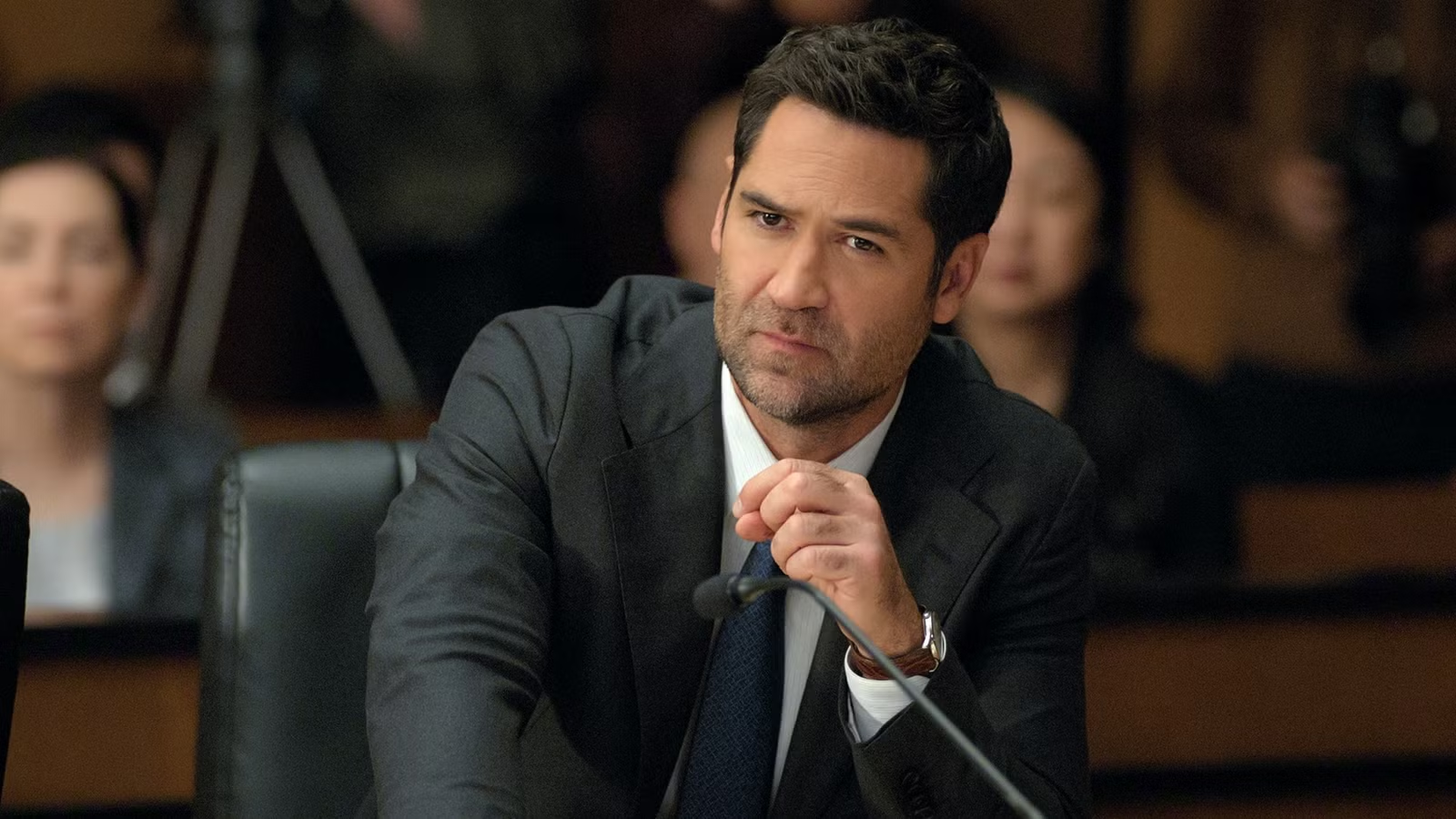
When the Lawyer Becomes the Accused: How Season 4 Pushes The Lincoln Lawyer to Its Breaking Point
Few legal dramas are brave enough to dismantle their own formula. The Lincoln Lawyer does exactly that in Season 4 by placing Mickey Haller, a defense attorney who has always controlled the courtroom narrative, on the other side of the bars. The result is the most emotionally loaded, thematically dense, and personally devastating chapter the series has delivered so far.
For the first time, Mickey is not advocating for a client whose innocence he believes in. He is fighting for himself, his future, and the people whose lives orbit around his own. This shift transforms the series from a procedural legal drama into a character-driven examination of identity, loyalty, and the psychological toll of being presumed guilty.
A Nightmare Born From a Traffic Stop
Season 4 opens in the aftermath of a moment that ended the previous season in shock. Mickey is pulled over in his signature Lincoln, ostensibly for a missing rear license plate. What begins as a routine stop escalates quickly when the officer notices blood leaking from the trunk. Inside is the body of Sam Scales, a former client, immediately placing Mickey at the center of a murder investigation.
The accusation is devastating not because of doubt, but because of certainty. Mickey knows he did not commit the crime. Yet the system he has spent his career navigating is now being weaponized against him. This inversion of power drives the entire season.
The story draws its foundation from Michael Connelly’s novel The Law of Innocence, but the series expands the material by grounding the legal mechanics in character psychology. From the opening moments, the narrative makes clear that murder is the most serious charge the state can pursue, and once that machinery starts moving, it rarely stops without resistance.
Prison, Perspective, and the Weight of Loss
Season 4 begins with Mickey incarcerated, stripped of status and autonomy, yet still instinctively practicing law by offering advice to fellow inmates. These scenes establish a core theme of the season: Mickey cannot stop being a lawyer, even when it costs him.
The voiceover framing murder as a towering tree nurtured by prosecutors becomes a guiding metaphor. Every episode adds another branch to that tree, another piece of circumstantial evidence, another pressure point designed to force a plea or collapse. Mickey’s task is not merely to defend himself, but to dismantle a case that is being constructed with near-perfect precision.
Family as the Emotional Backbone of the Season
What elevates Season 4 beyond courtroom tension is its intense focus on the people who stand behind Mickey when he can no longer stand on his own. Manuel Garcia-Rulfo delivers his most layered performance yet, balancing optimism, fear, stubborn pride, and quiet desperation.
Mickey’s ex-wives, Maggie and Lorna, emerge as emotional anchors. Maggie, portrayed by Neve Campbell, brings a mix of prosecutorial sharpness and personal vulnerability that deepens her role considerably. Lorna, played by Becki Newton, steps into leadership with surprising confidence, holding the law office together while navigating her own legal growth.
Mickey’s absence ripples outward. His daughter Hayley feels the instability. Cisco, his investigator, and Izzy, his assistant, are forced to step up in unfamiliar ways. Each supporting character is given room to evolve, making the season feel expansive rather than insular.
The Office Survives Without Its Star
With Mickey behind bars, the law office faces an existential threat. Clients drift away, unsure whether the firm can function without its namesake. Lorna’s determination to keep the practice alive becomes one of the season’s most satisfying subplots.
A new client, Celeste, provides Lorna with an opportunity to prove herself. What initially appears to be a standard divorce case turns into a test of creativity and legal instinct. The resolution of that case not only validates Lorna’s growth but reinforces the idea that Mickey’s greatest legacy may be the people he trained, not just the cases he won.
Izzy’s storyline expands as well, particularly through her connection with Grace, a law student whose digital forensics skills become crucial. Their relationship blends personal stakes with professional utility, reflecting how modern legal battles are increasingly fought through data as much as testimony.
Enter “Death Row” Dana
No murder trial is complete without a formidable prosecutor, and Season 4 introduces one of the most intimidating adversaries Mickey has ever faced. Dana Berg, known as “Death Row” Dana, is played with chilling control by Constance Zimmer.
Dana is not simply aggressive; she is methodical, relentless, and deeply familiar with Mickey’s tactics. Their history adds an undercurrent of rivalry that sharpens every courtroom exchange. Maggie’s past connection to Dana introduces another layer of tension, revealing fractures in old alliances and complicating professional loyalties.
Dana’s presence transforms the trial into psychological warfare. She anticipates Mickey’s moves, counters them before they fully unfold, and forces him into risky decisions that carry consequences beyond the courtroom.
The Trial as a Moral Reckoning
As the season progresses, Mickey is forced to confront uncomfortable truths about his past clients, his professional shortcuts, and the enemies he may have underestimated. Every advantage he once relied upon is now scrutinized by the prosecution.
The courtroom scenes are sharper and more unforgiving than in previous seasons. Objections feel personal. Evidence feels suffocating. Each hearing chips away at Mickey’s certainty, even as he projects confidence outwardly.
This season demands more from its ensemble, and it delivers. Even recurring characters and brief appearances are used to connect the series’ past to its present, reinforcing the sense that Mickey’s entire career has led to this moment.
Mentorship and Memory
One of the quiet highlights of Season 4 is the continued presence of David “Legal” Siegel, portrayed by Elliott Gould. As Mickey’s mentor and emotional compass, Siegel provides grounding wisdom without sentimentality.
In a season defined by instability, his role underscores the importance of guidance and institutional memory. While Mickey’s mother looms large in myth, Siegel represents the steady influence that shaped him into the lawyer he became.
Stakes That Redefine the Series
Season 4 succeeds because it makes everything feel irreversible. Mickey is not solving a case; he is fighting erasure. Reputation, freedom, fatherhood, and identity are all on trial simultaneously.
The narrative momentum never relies on gimmicks. Instead, it trusts character decisions to drive tension. Some of those decisions are shocking, others quietly devastating, but all of them feel earned within the logic of the story.
By the time the trial reaches its resolution, the series has fundamentally altered its own landscape. Mickey Haller is no longer just the man with the answers. He is the man who has survived the system he once mastered, changed by the experience in ways that will echo long after the verdict is read.
With Season 5 already confirmed and set to draw inspiration from Resurrection Walk, the foundation laid here ensures that whatever comes next will carry the weight of everything Mickey has already lost, fought for, and endured.