A Knight of the Seven Kingdoms’ Review: The Perils of Adhering Too Closely to the Source Material
When a beloved book series transitions into a television adaptation, expectations are always high. Fans expect to see their favorite characters brought to life and the rich worlds they’ve come to adore translated onto the screen. But sometimes, a show’s decision to stick too rigidly to the original material results in a missed opportunity for creative evolution. A Knight of the Seven Kingdoms, HBO’s adaptation of George R.R. Martin’s Dunk & Egg novellas, falls squarely into this category, as its first season offers a faithful yet underwhelming take on the source material. While the adherence to the novella’s dialogue and storyline might please purists, it ultimately leaves the show feeling like a mere shadow of what it could have been.
The Plot of A Knight of the Seven Kingdoms
Set in the same A Song of Ice and Fire universe as Game of Thrones, A Knight of the Seven Kingdoms takes place decades before the events of the main series. It focuses on the adventures of Ser Duncan the Tall, or Dunk, and his young squire, Egg, who will one day become King Aegon V. Their journey is filled with tournament jousts, political intrigue, and interactions with the Targaryen family, setting the stage for events that will have far-reaching consequences in Westeros.
The show opens with Dunk attending a tournament in Ashford, where he meets a variety of characters, including the infamous Targaryens and other powerful nobles. As Dunk navigates the world of Westerosi knighthood, he and Egg must deal with both personal and political challenges. The show highlights their deep bond as they journey together, emphasizing themes of honor, duty, and friendship.
A Loyal Adaptation with Few Surprises
One of the most noticeable aspects of A Knight of the Seven Kingdoms is how closely it sticks to the events and dialogue of Martin’s The Hedge Knight, the first novella in the Dunk & Egg series. This level of loyalty to the source material is evident in the show’s verbatim retelling of many scenes, and while this may appeal to die-hard fans of the novellas, it also means the series struggles to stand on its own. The script is littered with lines directly lifted from the novella, which gives the show a sense of staleness that holds it back from finding its own identity as a television series.
The pacing of the show also suffers from this adherence to the novella. With only six episodes in the first season, the show feels cramped and rushed, especially given the limited source material. The novella, The Hedge Knight, is relatively short, spanning just over 60 pages. While it offers rich character development and a satisfying plot, it is hardly the stuff of epic television. Instead of expanding on the material to make it fit into a more structured television season, the writers have opted for a direct translation that doesn’t allow the story to breathe or develop more fully.
Dunk: The Protagonist Who Doesn’t Spark Much Excitement
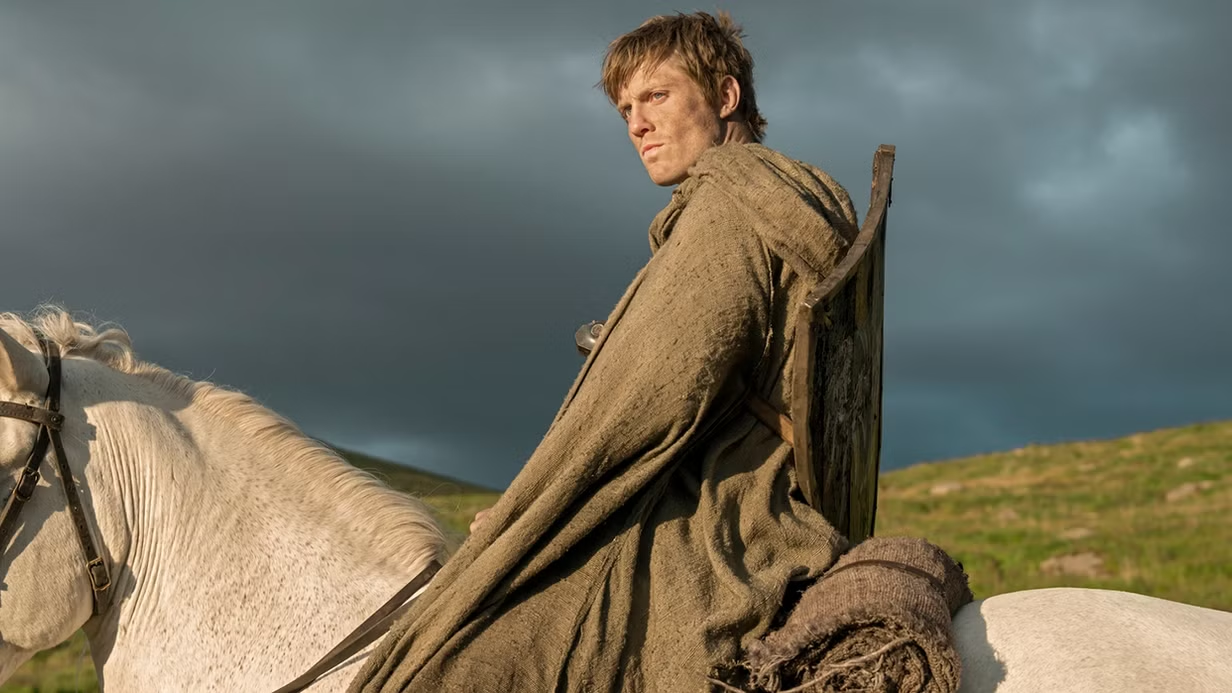
At the heart of the show is Dunk, played by Peter Claffey, a noble but humble knight with a heart of gold. Dunk’s character, while likable, is rather one-dimensional. He’s a “good guy” through and through, embodying the classic archetype of the virtuous knight. However, this creates a problem for the show: Dunk, though endearing, is simply not compelling enough to carry an entire season. His chivalry and earnestness make him a solid protagonist, but in a world full of morally complex characters like those seen in Game of Thrones, Dunk feels lacking in depth and complexity.
In contrast, Egg (played by Dexter Sol Ansell), his squire, is far more interesting. The young boy who will one day become Aegon V, Egg is brash, witty, and unafraid to challenge authority. Ansell’s performance injects much-needed energy into the series, and it’s clear that Egg’s future significance in the Targaryen lineage adds a layer of intrigue to the show. However, even Egg, who could have been developed further, is relegated to the sidelines, as Dunk dominates most of the screen time.
A World of Colorful Characters Left Unexplored
Although Dunk is the central figure, the show’s supporting characters are arguably the most intriguing. Characters like Lyonel Baratheon (played by Daniel Ings) and the Targaryens, including Baelor Breakspear (Bertie Carvel) and Aerion Targaryen (Finn Bennett), have far more potential than the show allows them to explore. These figures are tied to Westeros’s history and have rich backstories that could have been expanded upon, but the series glosses over these characters in favor of Dunk’s story.
Baratheon, for example, is a boisterous and charismatic character with deep ties to the history of Westeros, yet the show barely scratches the surface of his character. Similarly, the Targaryens, often the most fascinating family in Martin’s work, are relegated to mere background players in this adaptation. Their brief appearances leave viewers craving more exploration of their history and personalities. The show seems content to merely hint at these characters’ potential rather than diving deep into their complexities.
The Show’s Visuals and Production
Another disappointment comes in the form of the show’s visual style. A Knight of the Seven Kingdoms doesn’t take full advantage of the epic fantasy world it occupies. While Game of Thrones was known for its grand battle sequences and stunning locations, A Knight of the Seven Kingdoms feels more constrained in its scope. Many of the jousting tournaments, a central part of the show’s action, are filmed at night or in poorly lit conditions, making it difficult to appreciate the action. The decision to limit the visual spectacle is puzzling, especially when considering that this series is set in the same universe that gave us dragons, direwolves, and unforgettable battles.
Moreover, the show’s cinematography often falls flat. For a series set in Westeros, with its rich landscapes and dark political intrigue, A Knight of the Seven Kingdoms feels visually underwhelming. The lighting and color schemes are often drab, and the locations, though fitting for the medieval setting, lack the grandeur seen in its predecessor. This absence of a visual spectacle detracts from the overall impact of the show.
The Female Characters: A Step Backwards
Another notable issue with the adaptation is the treatment of its female characters. For a show that exists within the Game of Thrones universe, which is known for its complex and strong female characters, A Knight of the Seven Kingdoms is remarkably devoid of substantial female roles. The few female characters that do appear, including the love interests and secondary players, are often underdeveloped and given little screen time. This stands in stark contrast to Game of Thrones and House of the Dragon, both of which featured strong, multi-faceted women at the forefront of their stories.
In one of the most controversial choices, the show’s script decides to “fridge” one of its few female characters, removing any potential for a meaningful narrative arc. This decision feels regressive, especially when compared to the other shows in the franchise, where female characters played pivotal roles in shaping the storylines.
Lighting and Action Sequences: Missed Opportunities
The action sequences in A Knight of the Seven Kingdoms also leave much to be desired. The series features some jousting tournaments that could have been thrilling but are marred by poor lighting and lackluster choreography. The fights and jousts should be the highlight of the series, given the historical context, yet they feel rushed and lacking in intensity. The dark, foggy settings often make it difficult to follow the action, which is a major disappointment for a show set in a world filled with knights, tournaments, and battles.
A Fan-Focused Yet Narrow Show
Ultimately, A Knight of the Seven Kingdoms feels like it was made primarily for Game of Thrones fans and those who are deeply invested in the A Song of Ice and Fire lore. The show makes little effort to introduce newcomers to its world or offer any significant exposition on the events surrounding the Blackfyre Rebellion or other key moments in Westeros’s history. For fans of the books, this may not be a problem, but for casual viewers, the lack of clear storytelling and character development could be alienating.
In many ways, the series feels like an extended bonus feature for die-hard fans rather than a standalone narrative. The lack of broader appeal, the slow pacing, and the missed opportunities to develop supporting characters or expand on important plot points make this adaptation feel incomplete. While the show may have its merits for those who are already familiar with the source material, for many, A Knight of the Seven Kingdoms will be a frustrating watch.