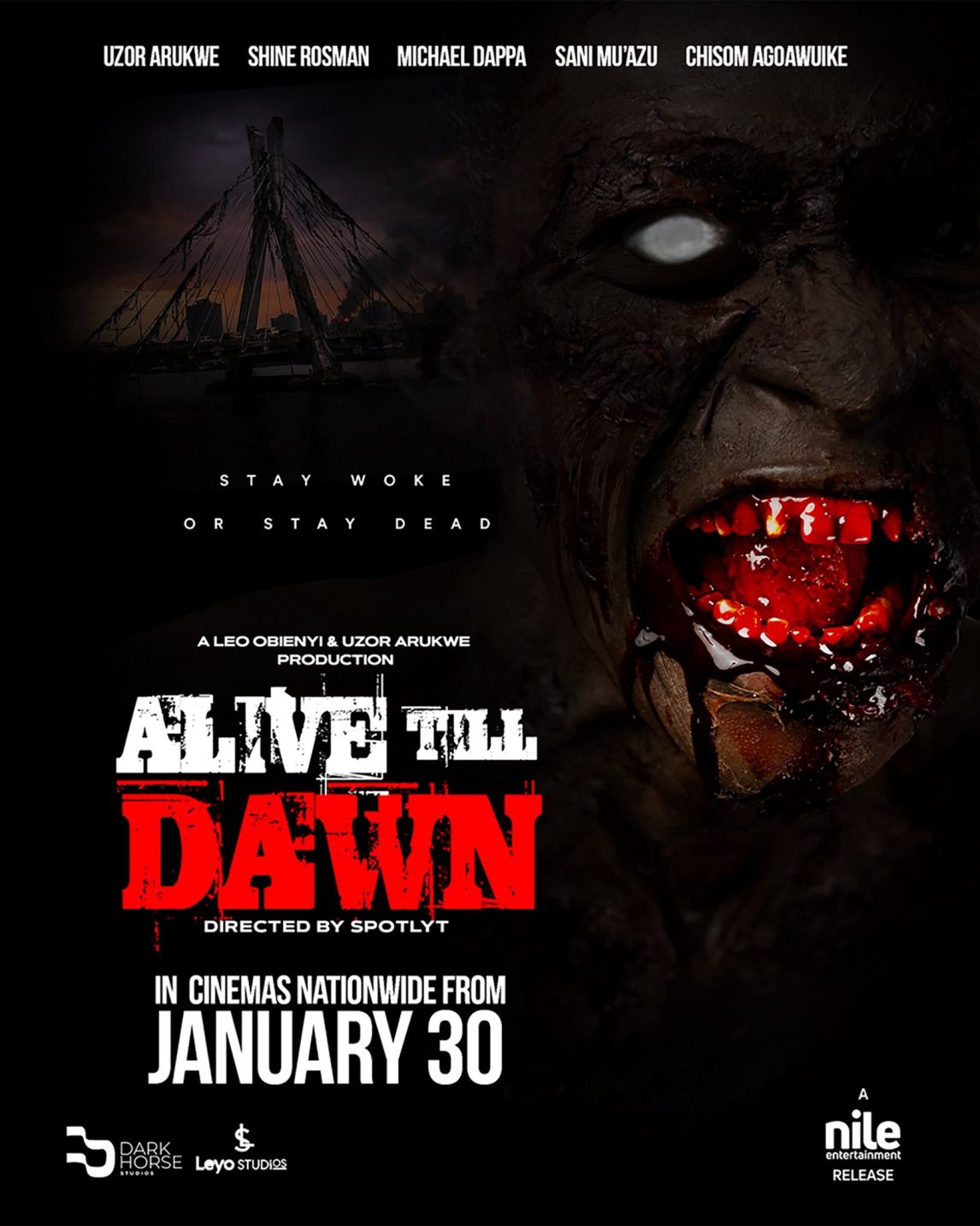
Alive Till Dawn Nollywood Zombie Film Review
Uzor Arukwe stepped behind the camera to co-produce Alive Till Dawn Nollywood industry watchers are discussing. This zombie thriller arrives at a curious moment where actors leverage visibility to bypass traditional gatekeeping. Released in Nigerian cinemas on January 30, 2026, the film positions itself as a commercial bet on genre viability. Arukwe uses his star power as collateral to greenlight a project studios might consider too niche. Innovation has become a marketing imperative even when the product remains formally conservative.
Claiming the First Zombie Film Title
The production bills itself as Nigeria’s first zombie apocalypse film. This claim requires immediate scrutiny given C.J. Obasi’s Ojuju from 2014. That zero-budget DIY zombie film set in Lagos slums exists as an incontrovertible precedent. Ojuju circulated primarily through festival circuits and never received a theatrical release. In Nollywood calculus, a film must play in multiplexes to count toward the official record. The first designation becomes less about chronological accuracy and more about market positioning. Alive Till Dawn Nollywood represents the first zombie film with proper distribution and recognizable stars. Institutional backing makes it legible as a mainstream product rather than an auteurist curiosity.
Genre experimentation within the industry demands established commercial frameworks to register as innovation. Obasi’s film was too marginal and aesthetically unruly for an industry oriented toward middle-class respectability. The new release arrives with polish and narrative conventions suitable for domestic multiplexes and international streaming buyers. Genre filmmaking functions as risk mitigation instead of radical departure. This distinction tells us something essential about how the industry understands creative boundaries.
The Actor-Producer as Industrial Symptom
Arukwe’s pivot into production mirrors a broader trend where popular actors use leverage to produce projects reflecting creative ambitions. This strategy is not vanity producing in the traditional sense. Stars recognize that their power can function as pre-sold IP in a crowded marketplace. When an actor attaches himself to a zombie film, he signals built-in audience appeal to distributors. The genre itself remains unproven locally, yet star power mitigates the risk. Alive Till Dawn Nollywood demonstrates how actors choose relatively unproven genres for their producing debuts.
Platforms hunger for local genre content that markets as culturally specific and globally familiar. Zombie films travel well internationally because they require minimal cultural translation. A Nigerian zombie apocalypse offers setting exoticism without demanding interpretive labor from international viewers regarding unfamiliar narrative conventions. This outward-facing orientation comes at a cost regarding cultural authenticity. The film borrows heavily from Western zombie cinema without meaningfully adapting conventions to Nigerian social realities.
Political Gestures and Narrative Narrowing
The film opens with a pointed political gesture involving workers dumping hazardous waste into a water body. An intertitle cites UNICEF data on child mortality from water-related illness. This invocation addresses infrastructural failure, environmental violence, and state neglect directly. Having made that gesture, the narrative immediately retreats into individualized melodrama. The story centers the daughter of a police officer rather than communities devastated by pollution. Alive Till Dawn Nollywood confines itself largely to a police station siege narrative.
The apocalypse becomes intimate rather than collective and filtered through insulated figures. Polluted water that inaugurates the crisis becomes a backstory rather than an ongoing indictment. Systemic horror narrows into personal survival melodrama. Nollywood often gestures toward critique but hesitates before fully implicating power. Situating the primary perspective within state-aligned characters inadvertently softens the political charge. The police station becomes a metaphorical bunker where institutional authority attempts to reassert coherence.
Horror Labels and Cultural Memory
Marketing the film as a first raises questions about the industry relationship to its own archive. Nigerian horror has deep roots in titles like Living in Bondage and Nneka the Pretty Serpent. These films terrorized a generation through engagement with occult economies and spiritual warfare. They were not commonly called horror in public discourse but rather spiritual or supernatural films. The horror label in Nigerian popular imagination is reserved for Western monster movies. Alive Till Dawn Nollywood positions itself within a lineage of Western horror instead of Nigerian spiritual cinema.
Adopting zombie iconography wholesale risks becoming a derivative spectacle without cultural translation. The undead do not resonate with Nigerian cosmologies of death, possession, or spiritual contamination. Audience responses during screenings revealed laughter at moments meant to be terrifying. Western horror conventions do not reliably translate into fear for Nigerian audiences because threats feel imported. The zombies are CGI monsters that do not carry the existential dread of local spiritual entities.
Technical Competence and Performance Issues
Visual competence within genre conventions stands out as a credit to the production team. Cinematography employs shadowy lighting and a roving camera that mimics zombie movement. Sound design creates moments of genuine atmosphere through eerie moans and realistic gunfire. Production values are noticeably higher than the guerrilla aesthetic of earlier attempts. The polish signals growing technical capacity but also increasing risk aversion. Alive Till Dawn Nollywood adopts genre trappings without reinventing genre grammar.
Performances remain uneven across the cast. Sunshine Rosman carries the emotional weight with determination despite contrived misfortunes in the script. Michael Dappa brings passion but veers into melodrama as a hyper-dramatic ex-prisoner. Arukwe’s antagonist role is sabotaged by exaggerated delivery and constant shouting. Dialogue oscillates awkwardly between pidgin and polished English, breaking character consistency. Early scenes establish class distinctions through speech that collapse as the film progresses.
The Illusion of Innovation
This film functions as aspirational genre cinema that wants credit for attempting something new. It seeks innovation as a branding exercise rather than a creative rupture. Such patterns appear symptomatic of contemporary Nollywood where firsts are declared with increasing frequency. Genre involves narrative structures and thematic preoccupations that must be engaged seriously. Alive Till Dawn Nollywood represents an industrial realignment absorbing genre filmmaking into the mainstream apparatus. Marketability takes priority over formal experimentation in this model.
Nollywood already possesses a robust tradition of speculative and horror cinema. Living in Bondage is a horror film even if it does not conform to Western taxonomies. These predecessors are not claimed when new firsts are announced. The film is competent enough to be watchable and ambitious enough to signal intent. It remains too cautious to be genuinely transformative. This project serves as a symptom of the genre turn rather than its fulfilment.
Future Implications for Nigerian Cinema
Commercial success may create space for more genre experiments if early box office reports hold. Success will likely be measured in narrow terms regarding budget recoupment and streaming deals. These are legitimate industry concerns that do not necessarily lead to more ambitious filmmaking. The films worth seeing emerging from this moment would engage seriously with Nigerian cosmologies. Dystopian narratives should reckon with specific ways state failure manifests locally. Alive Till Dawn Nollywood does not deliver that depth but its existence tells us where the industry stands.
The conversation about what genre can do and how it might articulate Nigerian anxieties remains urgent. This film is one attempt at an answer that will not be the last. Audiences and platforms will reveal whether they reward formal experimentation or demand more of the same. The trial balloon tests whether different packaging satisfies the desire for innovation. For now, the answer seems to favor familiar templates with new skins. The industry remains caught between the desire to be seen as formally innovative and the unwillingness to abandon commercially safe templates.